
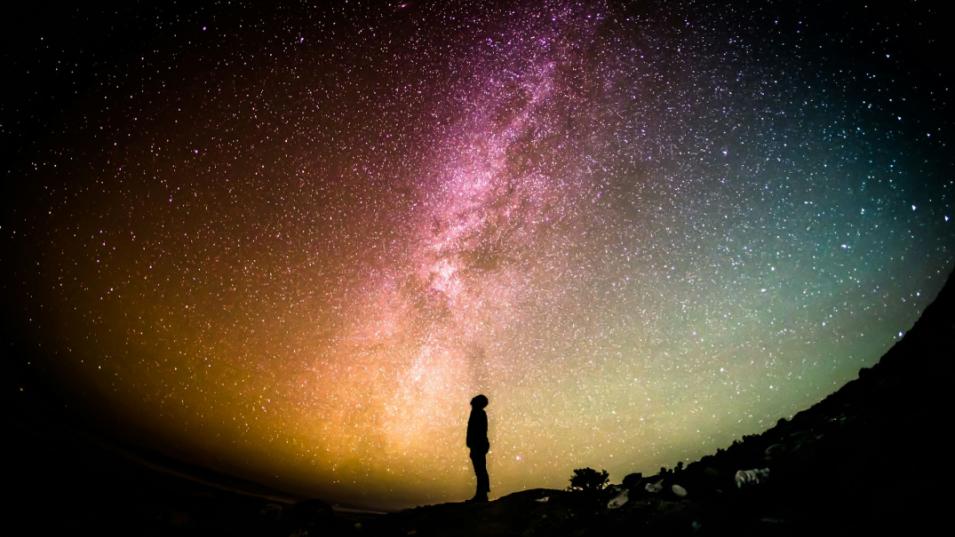
In 1929, Edwin Hubble looked into the sky and made a discovery that changed human history: galaxies weren’t fixed in place, they were moving away from us. This meant the universe was expanding, and if it was expanding, then it had a starting point.
But here’s the part most people don’t know…
The first person to propose that idea wasn’t Hubble, it was Georges Lemaître, a Belgian physicist, mathematician, and Catholic priest. Years before the scientific community took the idea seriously, Lemaître suggested that the universe began as a “primeval atom,” an explosive moment where all matter, space, and time were born.
In other words, the Big Bang theory came from someone who saw no contradiction between science and God.
The implications
So, every major field of physics now agrees that the universe is not eternal.
The expansion of space, the microwave background, and the second law of thermodynamics all point back to a beginning, a moment when everything simply wasn’t, and then suddenly was. Physics, not faith, is what forced that conclusion.
The Big Bang wasn’t an explosion inside the universe, it was the moment the universe itself came into existence: time, matter, energy, and the very laws that govern our reality today.
That raises the question science can’t explain:
Why was there a beginning at all?
Cause and Effect
Physics is built on causality, things do not “just happen.”
- Stars ignite because gravity compresses hydrogen
- Particles interact because forces make them interact
- Energy moves because the laws of thermodynamics make it move
So, when the universe began, whatever triggered that beginning had to exist outside space and time, because space and time themselves didn’t yet exist. That doesn’t automatically prove God however, but it points away from randomness.
Lemaître understood this better than most, he didn’t invent the Big Bang to prove God; he simply followed the math to its conclusion. But he also recognized that a universe with a starting point naturally raises the possibility of a “creator.”
The Universe Was Built Like It Was Intended
From the moment of the Big Bang, the constants of physics were dialed in with perfect precision: the gravity, the electromagnetic force, the expansion rate, even microscopic variations would make the formation of stars or atoms impossible.
Some scientists call this the “fine-tuning problem.”
You don’t need theology to see the implications… the universe behaves like something engineered, not a cosmic accident that stumbled into order.
Science Doesn’t Close the Door on God
Some people like to frame the Big Bang as proof the universe didn’t need God. But the theory itself came from Lemaître, a man with one foot in the lab and one foot in the Church.
He believed science described how the universe began, not why.
Even if you strip away theology completely, the Big Bang still confronts you with facts:
- The universe had a beginning
- It began from outside space and time
- Its structure and laws appeared instantly
- It behaves like something tuned, not random
Those aren’t religious claims, they are scientific ones, and they inevitably point toward something deeper.