A few years ago, making art meant learning a skill.
You practiced. You messed up. You tried again.
Bad sketches filled notebooks. Paint dried wrong. Proportions were off. Nothing looked how you imagined.
It was frustrating.
But it was yours.
Now you can type five words into an AI generator and get a flawless image in ten seconds.
“Neon city in the rain.”
“Renaissance angel portrait.”
“Album cover, cinematic lighting.”
Done.
No training. No mistakes. No waiting.
Technically, it’s incredible. The images are sharp, beautiful, almost magical.
And yet… something about them feels hollow.
Not bad. Just distant.
Like looking through glass instead of touching something real.
Because when you stand in front of a hand-painted canvas or flip through someone’s sketchbook, you feel more than the picture. You feel the person behind it.
You see the hesitation in the lines. The places they corrected. The tiny flaws where the hand slipped.
Those imperfections aren’t weaknesses.
They’re fingerprints.
They’re proof someone stood here, breathing, thinking, struggling a little to make this exist.
AI doesn’t struggle. It calculates.
It doesn’t spend three hours mixing the wrong color and starting over. It doesn’t doubt itself. It doesn’t care.
It just produces.
Which raises a weird question we didn’t have to ask before:
If beauty can be generated instantly… what gives art its value?
Maybe it was never the result.
Maybe it was the cost.
Time given. Attention offered. Presence invested.
Maybe what we love about art isn’t perfection, but sacrifice — the quiet offering of effort.
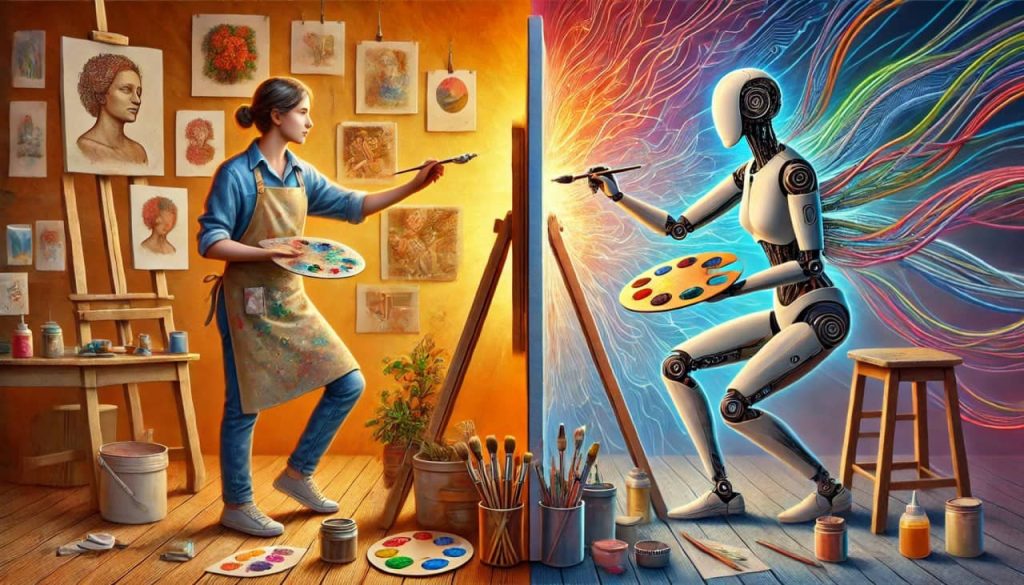
One cost nothing.
The other cost time, love, and passion.
In a world racing toward faster and easier everything, maybe the most human thing left is choosing to make something slowly.
Not because it’s efficient.
But because it’s real.
Because you were there.
Because your hands touched it.
Because it carries you inside it.
Maybe art isn’t just about what we create.
Maybe it’s about proving we were here at all.
“it is not how much we do… but how much love we put in that action”. Mother Teresa