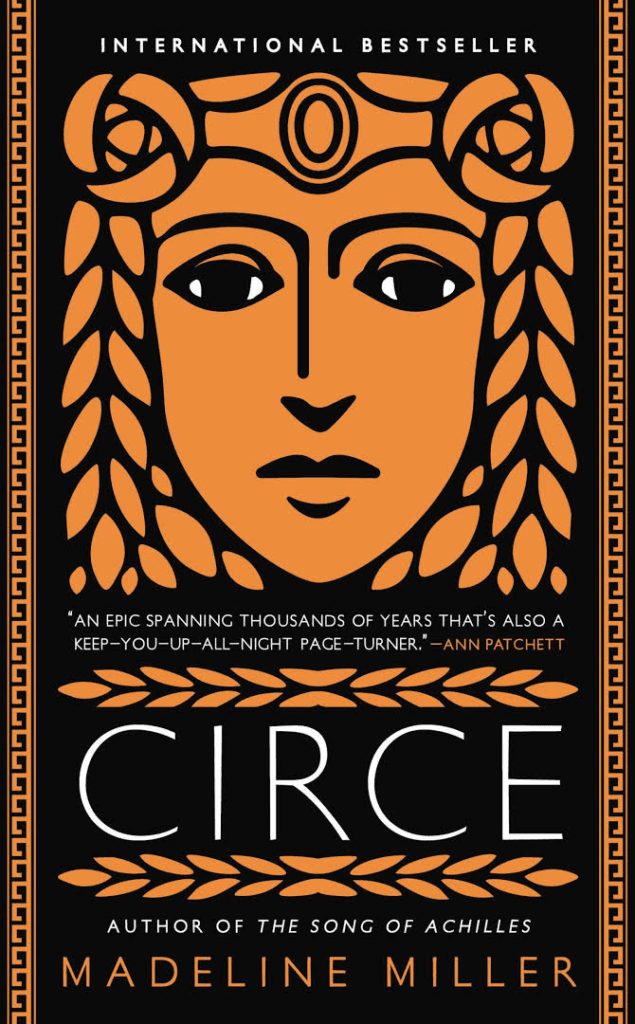
For anyone familiar with Greek mythology, Madeline Miller’s Circe offers a different perspective on a familiar story. Rather than focusing on the titular character Odysseus, Miller centers on the often-overlooked witch Circe, following her journey from an overlooked nymph to a woman who ultimately chooses her own path. While the novel explores identity, agency, and loneliness, it also suggests that purpose is not predetermined by fate but discovered through choice.
From the moment she’s born, Circe’s identity and fate are determined by men far more powerful than she.
“When I was born, the name for what I was did not exist. They called me a nymph, assuming I would be like my mother and aunts and thousand cousins. Least of the lesser goddesses, our powers were so modest they could scarcely ensure our eternities. […] That word, nymph, paced out the length and breadth of our futures. In our language, it means not just goddess, but bride.” (Circe, 1)
After discovering her gift for witchcraft and using the flower moly to transform a mortal into a god and a nymph into a monster, Circe is exiled to the remote island of Aeaea. There, she relishes in her freedom, meditates on her faults, and grapples with the isolation. All the while, she remains resigned to the fate imposed upon her, despite her newfound freedom. Many moons later, Odysseus and his crew are forced to seek refuge on Aeaea during their journey home from Troy. They stay for several seasons and, shortly before departing, Odysseus unknowingly fathers a son with Circe. Left to raise Telegonus alone, Circe dedicates herself to protecting him from Athena, who wishes him dead, and the dangers of the world beyond the island. As he grows older, Telegonus’ desire to know his father and life beyond the island grows and creates conflict between them. During an argument with his mother, he shouts,
“Fear and the gods, fear and the gods! That is all you talk about. It is all you have ever talked about. Yet a thousand men and women walk this world and live to be old. Some of them are even happy, Mother. They do not just cling to safe harbours with desperate faces. I want to be one of them. I mean to be. Why can’t you understand that? […] There is nothing for me here.” (Circe, 270-271)
In a crude way, Circe has gone from a prisoner of a fate others have charted for her to being a captor of another. Out of love and fear, she shelters him from the terrors of the outside world. For her son, ignorant to her sacrifices and driven by curiosity, a life ruled by fear is not one worth living. After agreeing to let him sail to Ithaca to meet his father, Circe acknowledges that this journey will allow him to discover his own purpose:
“It is likely you are not a witch.” I said. “But you are something else. Something you have not found yet. And that is why you go.” (Circe, 275)
As hard as it is for her to let him go, Circe came to see that purpose is discovered, not inherited or protected into existence. Just as she had grown beyond the identity of nymph, wife, and outcast imposed upon her by her family and the gods, Telegonus must leave the safety of Aeaea and define himself through his own experiences. Miller suggests that finding one’s purpose requires the freedom to choose the path you travel on rather than staying on one out of fear or others’ expectations. Circe’s growth is captured in the novel’s closing pages:
“With every step I felt lighter. An emotion was swelling in my throat. It took me a moment to recognize what it was. I had been old and stern for so long, carved with regrets and years like a monolith. But that was only a shape I had been poured into. I did not have to keep it.” (Circe, 373)
Circe’s final reflection shows that she has finally rejected the identity imposed upon her. By choosing a new life of her own making, she embodies Miller’s message that purpose is not something we inherit, but something we create through our own choices. In the end, Circe argues that freedom is not only the absence of chains, it’s also the courage to step off a path predetermined for us and embrace the uncertainty of a life we choose for ourselves. Purpose is not in the waiting or found when you’re idle. It’s revealed with each step forward we take.
Candidly, any book that makes me cry becomes an instant favourite. I first read Circe during a season of major change after graduating university. Like Circe, I instinctively want to protect the people I love. As a sister, I want to shield my siblings from making mistakes and shouldering burdens, just as Circe tries to protect Telegonus from the world. Seeing her mirror my own shortcomings reminded me that loving someone doesn’t mean choosing their path or protecting them from every hardship. Sometimes love looks like letting go.
Moving forward, I want to let go of my need for control and focus instead on the next right thing. As Circe ultimately discovers, purpose isn’t found in having every step planned. It’s found by having the courage to take the next one.