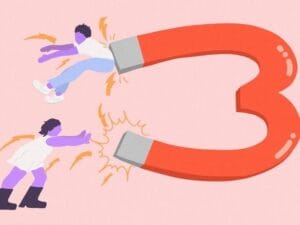
Let me ask you something. If I told you there was a 50/50 chance to either win $100 or lose $100, would you take that bet? Surprisingly, most people wouldn’t, and honestly, that’s not irrational on the surface. The reason why most people say no is more interesting than you’d think, and it’s quietly wrecking a lot of your financial decisions.
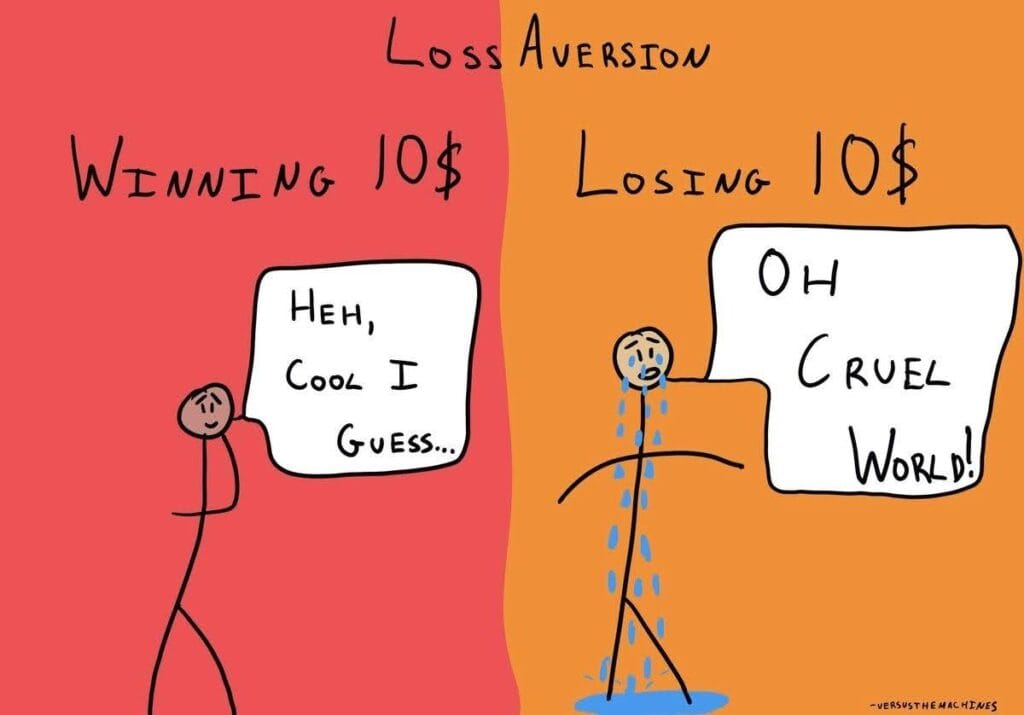
There’s a name for what’s happening in that moment: loss aversion. It’s a concept that came out of the work of two psychologists, Daniel Kahneman and Amos Tversky, who spent decades studying how people actually make decisions, not how they’re supposed to make them in theory. What they found was striking…losing something hurts about twice as much as gaining the same thing feels good. That’s not a metaphor; it’s a measured psychological response. The pain of losing $100 registers roughly twice as intensely as the pleasure of gaining $100, so when you pass on that coin flip, you’re not being cautious, it’s how your brain is wired.
Your Brain Was Built for Survival, Not Investing
The problem is that wiring made sense for our ancestors, when you’re trying to survive, avoiding a loss: your food, your shelter, your safety, is more urgent than chasing a gain. Losing could mean death, whereas gaining was a bonus. But we’re not hunting mammoths anymore, and that same instinct is now showing up in your brokerage account, and it’s doing real damage.
The Trap Most Investors Fall Into
Here’s where it gets costly… Think about the investor who buys a stock at $50, watches it drop to $35, and holds on for dear life because selling would “make the loss real.” So, they sit on it, sometimes for years, hoping it climbs back to $50 so they can break even. Meanwhile, that $35 could have been redeployed into something with actual momentum. The stock doesn’t know what you paid for it; the market doesn’t care about your break-even point. But loss aversion keeps people anchored to a number that only exists in their head.
It also works in reverse though. When a stock goes up, people tend to sell too early, locking in the profits before it “disappears.” So, they cut their winners short and let their losers run, which is almost exactly backwards from what builds long-term wealth.
The Biggest Mistake
Then there’s the most expensive version of this trap: not investing at all. A lot of people sit on cash or a savings account not because they’ve done the math, but because investing feels like stepping into a space where loss is possible. And since loss feels worse than gain feels good, the brain treats “do nothing” as the safe option. But inflation doesn’t care about your feelings. Sitting on cash at 2% while inflation runs at 3% is a guaranteed loss, but just a slow and invisible one. Loss aversion ironically leads people straight into the loss they were trying to avoid.
How to Actually Fight It
Awareness is step one, but it’s not enough on its own. The more practical answer is to remove as many active decisions as possible: automate your contributions, set your asset allocation and stop checking it daily. If you’re an index investor, the strategy itself is the discipline, you’re not picking stocks, so there’s less to second-guess. The less often you’re forced to make a decision in the middle of market noise, the less leverage loss aversion has over you.
None of this means you should be reckless! Risk matters, but there’s a difference between thoughtful risk management and letting fear of loss quietly steer every financial move you make. One is a strategy, the other is just anxiety dressed up as caution.
*Disclaimer: I’m not a financial advisor. This content is for educational purposes only and shouldn’t be taken as financial advice. Always do your own research or consult a licensed professional before making financial decisions*
References
Kahneman, D., & Tversky, A. (1979). Prospect Theory: An Analysis of Decision under Risk. Econometrica, 47(2), 263–291.
Kahneman, D. (2011). Thinking, Fast and Slow. Farrar, Straus and Giroux.